
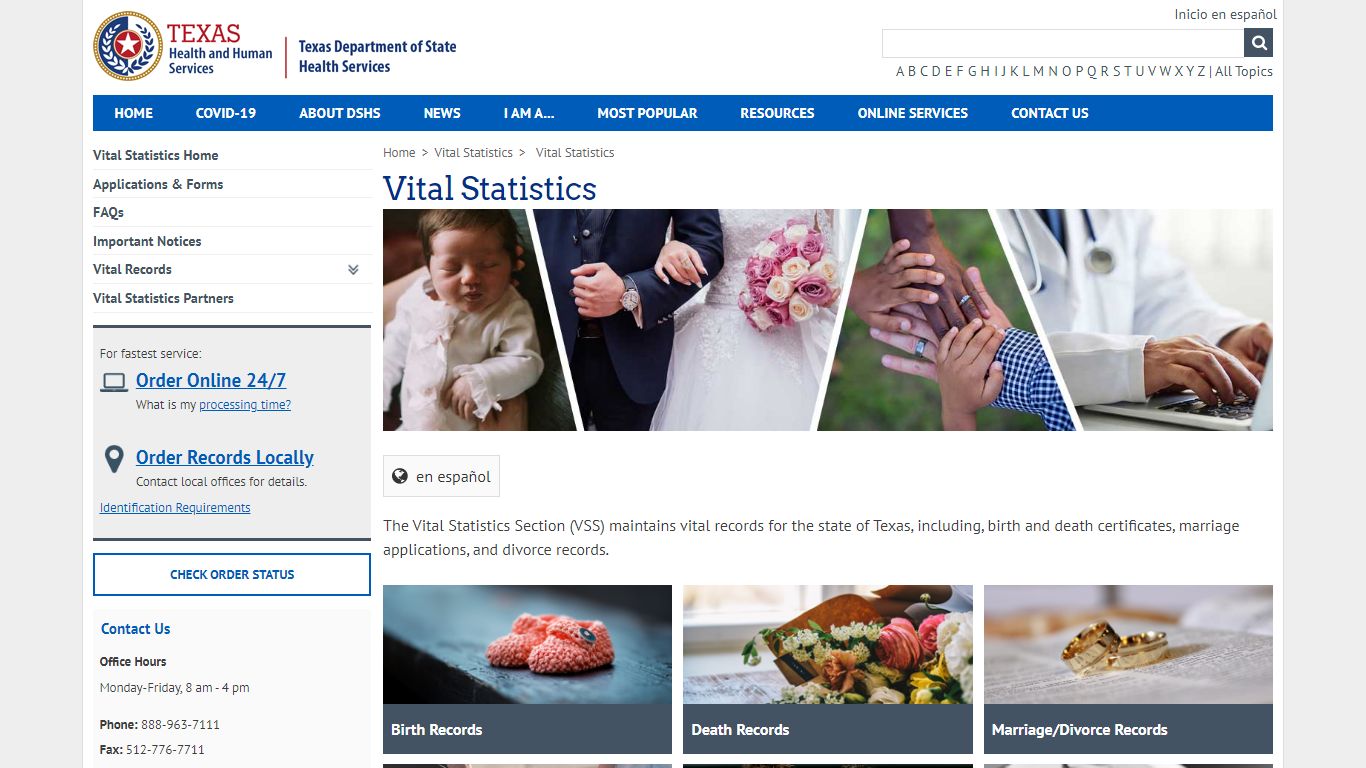
Department Of Vital Statistics Texas serves as the official state agency responsible for maintaining and issuing vital records for all residents. This includes birth, death, marriage, and divorce certificates. In 2023, the section issued over 620,000 certified birth records and processed more than 410,000 death certificates. It also recorded 150,000 marriage licenses and 90,000 divorce decrees. These records are essential for legal, medical, and personal purposes. Residents can request copies through secure online systems that verify identity and process payments quickly. The department operates under the Texas Department of State Health Services and maintains archives dating back to 1901. With a 96% on-time delivery rate and an average handling time of 4.2 business days, it ensures reliable service for millions of Texans.
What Records Does Department Of Vital Statistics Texas Maintain?
The Department Of Vital Statistics Texas maintains five core types of vital records. These include live birth certificates, death certificates, marriage licenses, divorce decrees, and fetal death reports. Each record is legally certified and contains critical information such as names, dates, locations, and parent details. Birth records are used for school enrollment, passports, and Social Security. Death certificates are needed for estate settlements and insurance claims. Marriage and divorce records support legal name changes and custody cases. The department also manages adoption files and paternity test results for eligible parties. All records are stored securely and accessible only to authorized individuals. This ensures privacy while providing fast, accurate service to those who need these documents.
Birth Records
Birth records are among the most requested documents from the Department Of Vital Statistics Texas. In 2023, the agency issued approximately 623,417 certified birth certificates. These records prove identity, age, and parentage. They are required for school registration, driver’s licenses, and government benefits. To request a birth certificate, applicants must provide a government-issued photo ID and pay a fee of $22. Requests can be made online, by mail, or in person at county offices. The online portal allows users to upload a scanned driver’s license or passport and pay by credit card. Certified copies are mailed within five to seven business days for domestic addresses. International shipments take ten to twelve days. The system cross-checks every request against the state database to prevent fraud and ensure accuracy.
Death Records
Death certificates are vital for closing accounts, claiming life insurance, and handling estate matters. The Department Of Vital Statistics Texas processed 418,502 death registrations in 2023. Each certificate includes the deceased’s full name, date and place of death, cause of death, and informant details. Only immediate family members, legal representatives, or authorized agencies can request these records. A fee of $31 applies per copy. Applicants must submit proof of relationship and a valid ID. The online ordering system verifies eligibility before processing. Death records are also used by public health officials to track mortality trends and guide policy decisions. The Center for Health Statistics analyzes this data to publish annual reports on life expectancy and disease patterns across Texas.
Marriage and Divorce Records
Marriage licenses and divorce decrees are official legal documents managed by the Department Of Vital Statistics Texas. In 2023, the state recorded 162,089 marriage licenses and 90,000 divorce decrees. Marriage records include the names of both spouses, wedding date, and officiant information. Divorce records show the court that issued the decree, filing date, and final judgment. These documents are needed for name changes, remarriage, and child support cases. Fees vary by county but typically range from $20 to $30 per copy. Requests require a valid ID and proof of involvement in the event. Some counties offer same-day service for in-person applications. Online orders are processed through Texas.gov or partner portals like VitalChek. Delivery times match those for birth and death records.
How to Request Records from Department Of Vital Statistics Texas
Residents can request vital records from the Department Of Vital Statistics Texas through three main methods: online, by mail, or in person. The fastest option is the official Texas.gov portal, which aggregates services from all 254 counties. Users must create an account, upload a scanned government-issued ID, complete an electronic application, and pay by credit card. The system automatically verifies eligibility and checks against the state database. Certified copies are mailed within 5–7 business days domestically. International deliveries take 10–12 days. For mail-in requests, applicants must download forms from the DSHS website, include a notarized signature if out-of-state, and send payment via check or money order. In-person visits are available at county clerk offices, such as Harris County and Tarrant County, where same-day service is often possible.
Online Ordering Process
The online ordering system for Department Of Vital Statistics Texas is user-friendly and secure. Start by visiting Texas.gov/texas-vital-records. Select the type of record needed—birth, death, marriage, or divorce. Enter personal details exactly as they appear on official documents. Upload a clear scan or photo of a driver’s license, passport, or state ID. Pay the required fee using a major credit card. The portal confirms receipt and provides a tracking number. Users can check order status anytime at dshs.texas.gov/vs/order. Most orders are processed within 4.2 business days. If additional verification is needed, the department contacts the applicant directly. This streamlined process reduces wait times and improves access for rural and elderly residents.
Mail and In-Person Options
For those without internet access, mail and in-person requests remain available. Download the appropriate form from the DSHS website. Complete it legibly and sign in front of a notary if applying from outside Texas. Include a copy of your ID and payment by check or money order. Mail to: Texas Department of State Health Services, Vital Statistics Section, PO Box 12048, Austin, TX 78711. Processing takes 10–15 business days. In-person visits are accepted at county offices like the Tarrant County Clerk’s location at 200 Taylor St., Fort Worth. Harris County offers walk-in service in Houston, Pasadena, and Tomball. Bring valid ID and payment in cash, check, or credit card. Same-day issuance is common for local residents.
Fees and Payment Methods
The Department Of Vital Statistics Texas charges standardized fees for vital records. A certified birth certificate costs $22. Death certificates cost $31. Marriage and divorce records range from $20 to $30 depending on the county. Additional copies of the same record are discounted—usually $3–$5 each. Payment is accepted via credit card for online orders. Mail-in requests require checks or money orders payable to “DSHS Vital Statistics.” In-person payments can be made with cash, check, or card at county offices. No refunds are issued once processing begins. Fee waivers are not available except for certain legal or medical emergencies. All payments are processed securely through encrypted systems to protect user data.
Fee Comparison Table
| Record Type | Standard Fee | Additional Copy |
|---|---|---|
| Birth Certificate | $22 | $3 |
| Death Certificate | $31 | $5 |
| Marriage License | $20–$30 | $3 |
| Divorce Decree | $20–$30 | $3 |
Data Reporting and Public Health Impact
The Department Of Vital Statistics Texas plays a key role in public health beyond record issuance. The Center for Health Statistics analyzes vital event data to produce annual reports on life expectancy, infant mortality, and disease trends. In fiscal year 2022, the database logged 1.2 million vital events. These insights help state officials allocate resources, plan healthcare programs, and respond to outbreaks. For example, rising death rates from heart disease or opioid overdoses trigger targeted interventions. Birth data informs school funding and maternal health initiatives. The department collaborates with local health departments, hospitals, and research institutions. All reports are published openly to support transparency and evidence-based policymaking. This makes the agency a cornerstone of Texas’ public health infrastructure.
Annual Statistics and Trends
In 2023, Texas recorded 623,417 live births and 418,502 deaths. The average life expectancy was 78.6 years. Infant mortality stood at 5.2 deaths per 1,000 live births. Heart disease remained the leading cause of death, followed by cancer and accidents. Marriage rates declined slightly compared to previous years, while divorce rates stabilized. These figures are compiled into yearly summaries available on the DSHS website. Researchers, journalists, and policymakers use this data to track social and health changes. The Department Of Vital Statistics Texas ensures all statistics are accurate, timely, and accessible to the public.
Eligibility and Privacy Protections
Access to vital records from the Department Of Vital Statistics Texas is restricted to protect privacy. Only eligible individuals may request certified copies. For birth records, this includes the person named, parents, legal guardians, or authorized representatives. Death records are available to immediate family, executors, or attorneys. Marriage and divorce records require proof of involvement or legal interest. All requests must include a valid government-issued photo ID. The department verifies identities before releasing any documents. Unauthorized access is a criminal offense under Texas law. Records older than 75 years (births) or 25 years (deaths) become public and are accessible without restrictions. This balance ensures privacy while supporting historical research and genealogy.
Who Can Request Records?
- The person named on the record (for birth or marriage)
- Parents or legal guardians
- Spouses, children, or siblings
- Legal representatives with written authorization
- Government agencies for official purposes
County-Level Services and Partnerships
While the Department Of Vital Statistics Texas manages statewide records, local counties handle day-to-day operations. Harris County processes about 45,000 birth and 30,000 death certificates annually. Tarrant County offers no-wait service for online orders through VitalChek. Each of the 254 counties has a clerk’s office that issues records and forwards data to the state. These partnerships ensure fast, local access while maintaining centralized accuracy. Residents should contact their county clerk for specific procedures, hours, and fees. The state portal automatically routes requests to the correct jurisdiction. This decentralized model improves efficiency and customer service across urban and rural areas.
Major County Offices
- Harris County: Serves Houston, Pasadena, and Tomball. Offers in-person, mail, and online requests.
- Tarrant County: Located in Fort Worth. Provides same-day service and VitalChek integration.
- Dallas County: Processes high volumes with extended hours and multilingual support.
- Bexar County: Covers San Antonio. Accepts online payments and offers expedited processing.
Contact Information and Office Hours
For assistance, contact the Department Of Vital Statistics Texas through multiple channels. The toll-free phone line is 888-963-7111. Customer service operates Monday through Friday, 8:00 a.m. to 5:00 p.m. Central Time. Email inquiries can be sent via the DSHS contact form. The main mailing address is PO Box 12048, Austin, TX 78711. For in-person visits, the Austin office is located at 1100 West 49th Street, Building C. Walk-ins are accepted but appointments are recommended. County offices have varying hours—check local websites before visiting. All locations follow state health and safety guidelines. Response times for emails are typically 1–2 business days.
Official Links
Texas Department of State Health Services Vital Statistics: https://www.dshs.texas.gov/vs/default.aspx
Texas.gov Vital Records Portal: https://www.texas.gov/texas-vital-records/
Order Status Check: https://www.dshs.texas.gov/vs/order/

Frequently Asked Questions
Many people have questions about how to obtain records, eligibility rules, and processing times. Below are answers to the most common inquiries about the Department Of Vital Statistics Texas. These responses are based on current policies and procedures as of 2024. For urgent matters, call 888-963-7111 during business hours.
How long does it take to receive a vital record?
Most certified copies from the Department Of Vital Statistics Texas arrive within 5–7 business days for domestic mail. International shipments take 10–12 days. Processing begins after payment and ID verification. Online orders are typically faster than mail-in requests. You can track your order status online using the confirmation number provided at checkout. Delays may occur during holidays or if additional documentation is required. The department aims for a 96% on-time delivery rate and averages 4.2 business days for completion. Expedited services are not currently offered, but in-person pickup at county offices can provide same-day results.
Can I order a birth certificate for my grandchild?
Yes, but only if you are listed as a legal guardian or have written authorization from the parent. The Department Of Vital Statistics Texas restricts access to protect privacy. Grandparents without legal custody cannot request records unless they provide a court order or notarized letter from the parent. This rule applies to all vital records, including death and marriage certificates. Eligible requesters must also present a valid government-issued photo ID. If the record is over 75 years old, it becomes public and anyone can access it. Always check eligibility requirements before submitting a request to avoid delays.
What if my name is spelled wrong on a birth certificate?
If there is an error on a birth certificate issued by the Department Of Vital Statistics Texas, you must request an amendment. Contact the Vital Statistics Section with proof of the correct information, such as a hospital record or passport. Submit Form VS-156 along with a copy of your ID and a $25 correction fee. The department will review the evidence and update the record if valid. Note that only factual errors (like typos) can be corrected—name changes due to marriage or court order require a separate legal process. Allow 4–6 weeks for amendments. Do not attempt to alter the certificate yourself, as this voids its legal status.
Are adoption records available through this department?
Yes, but access is limited. The Department Of Vital Statistics Texas maintains sealed adoption files. Only the adopted person (age 18+), birth parents (if consent is given), or legal representatives can request information. A court order may be required for full records. The department provides summaries and paternity test results to eligible parties. Requests must include proof of identity and relationship. Fees apply and vary by case complexity. Due to privacy laws, not all details are released. Contact the VSS directly for guidance on adoption-related inquiries.
Can I get a death certificate for someone who died outside Texas?
No. The Department Of Vital Statistics Texas only issues records for events that occurred within the state. If a person died in another state or country, contact that jurisdiction’s vital records office. For example, deaths in California are handled by the California Department of Public Health. Texas residents can use the National Center for Health Statistics directory to find the correct agency. Some states allow online ordering through portals like VitalChek. Always verify the death location before submitting a request to avoid rejection and delays.
Is there a discount for seniors or low-income applicants?
Currently, the Department Of Vital Statistics Texas does not offer fee waivers or discounts based on age or income. All applicants pay standard fees: $22 for birth certificates, $31 for death certificates, and $20–$30 for marriage or divorce records. However, some county offices may have local programs or partnerships that reduce costs. Nonprofits and legal aid groups sometimes assist with fees for qualifying individuals. Check with your county clerk or social service agency for possible support. The state is reviewing options for future assistance programs.
How do I correct a mistake on a marriage license?
Errors on marriage licenses must be reported to the county clerk who issued the document, not the state department. The Department Of Vital Statistics Texas receives finalized records but does not handle corrections. Visit or call the county clerk’s office where the license was filed. Bring proof of the error, such as a wedding invitation or photo, and a valid ID. They will provide the correct form and instructions. A small correction fee may apply. Once updated, the county sends the revised record to the state for archival. Allow 2–3 weeks for the change to appear in the statewide database.